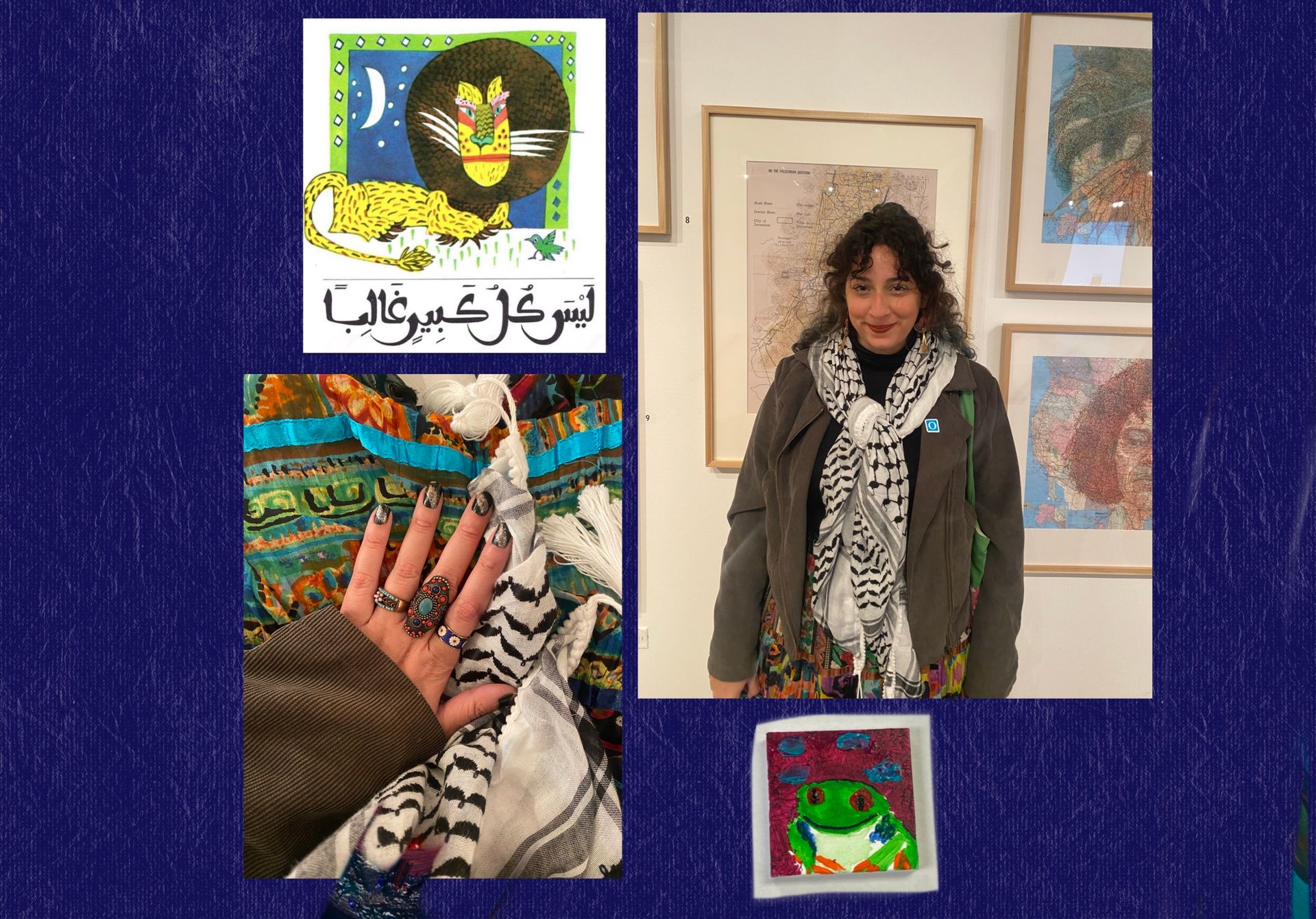
It took me a decade of work and life, two genocides (Gaza and Sudan), unemployment due to global funding cuts in the NGO sector, a chronic autoimmune condition that attacks my spine and 3 years of chronic pain and health issues, to very clearly arrive at the fact that my true core motivation in justice and community work is primarily about healing. Collectively and individually, ecologically, and for my people (and all people) to access a good quality of dignified life, work and living. The reality and process of my body getting sick in all its systems, made me think ever so deeply and seriously on what it means to be well. If the systems and realities that surround us are not only extremely unsupportive, but even violent and destructive, isn’t getting sick an indication of the health of our humanity?
I spent years and years organizing my life on all that I’m against, all the systems that aren’t life-affirming and caring to the most vulnerable in our societies, knowing that the reasons for doing so are “obvious”. But what does it really mean to be well?
My relationship to this work
I come to the mental health field from a social and political sciences and humanities background. I did my masters in peace, conflict and justice studies. And during my masters, I discovered liberation psychology, which offered further depth and grounding to much of what I have always known about health both physically, collectively and mentally, and explained why I have issues with western references of psychology which approach the individual in a very limited way in my opinion. Liberation psychology asks: what if the individual nervous system isn’t the first unit to investigate? What if we think of the nervous system in a collective, ecological and communal way? Which of our "symptoms" are actually reasonable responses to oppressive conditions?
I have worked with communities impacted by violence, wars, displacement and a wide array of injustices. I also come from these communities. I come from a family of single mothers. My parents were children during the Arab - Israeli war. My mom was present in the public independence parade where our president at the time was assassinated in an open fire assassination. My mom casually shared that one time. My mom, although well educated, was always struggling with money, at times working 3 jobs while as the eldest daughter of my siblings (whom their father died) I had to step up on the care duties. My mom cannot afford to take time off work to rest even now in her fifties, which always worries me about her health. My auntie is the same. My fights with them are primarily about their health and how they need to take time off to rest. I come from a collectivist culture, our individual health is connected to the environment and the people that surround us. I think a lot about my lineage of women, how I’m able to access things my mom, auntie and grandmother never even had as options, and also what they had that I don’t have. They have inherited assets for each of them, even though they were always middle class and have a lot of financial debts. My most expensive “asset” besides my body and mind is my laptop. I don’t have a car or an apartment. I am the first in my family to have a master's degree. And more “freedom” to choose a career pathway. But who is truly free in a capitalist world?
My masters was concluded with a portfolio thesis, and my substantial research was on politicizing intergenerational joy, healing and wellness. I’ve learnt from indigenous scholars on how unlike generational trauma (which tends to move down to younger generations) generational healing can go both ways. I’ve felt this in how my mom is encouraged to explore and rediscover herself in her fifties. My “personal“ healing and wellness moves both forward and back, it isn’t really “indiviidual”. it heals and honors my lineage, especially my lineage of women. She even told me once that I inspire her. And nothing brings me more comfort than knowing that her and my auntie are taking steps to take care of their health. I have succeeded in beginning a shift in the culture around health in my family, and none of us are perfect or feel satisfied with where we are in our health journeys, but the fact that we’re on that journey intentionally and persistently is comforting.
Any initiative that doesn’t center the needs of communities in an equitable way I think lacks essential ingredients. AAnd any initiatives that don't center both justice and health/social healing also lack essential ingredients. I wish to see more practical discussions and actions on the praxis of conflict transformation, restorative, transformative, reparative and healing justice. A praxis on collective ongoing trauma-causing realities, narrative transformation and community mental health and psychosocial support. Health interventions (whether physical, mental or spiritual) that remove individuals from the contexts and root issues that produced and caused their illnesses are doomed to be unsustainable in their impact.
While many spaces, programs, and people still regard these as separate domains, each requiring its own approach, its own experts, its own project activities,we need to design and develop interventions and programs that are built in a way that acknowledges the wholeness that emerges when disciplines are allowed to be in conversation with one another rather than kept apart. Especially when it comes to health, justice and wellness. Conflict, trauma, memory, justice, accountability, social protection, and health/wellbeing are deeply intertwined in our lived and shared lives and experiences. Why, then, does our mainstream collective praxis and projects fail to reflect that interconnectedness fully?
And I get the general arguments of the need for specializations and the scarcity of resources and the need to be “focused” but I feel that the response to those challenges isn’t to separate these efforts, but rather to figure out how to organize and design new systems and models of financial sustainability, collaboration and to politicize our tools in the world of NGO/non profit industrial complex. Our work is complicated, but so are we. We are many, we are multi- talented, we just need to get brave together. In navigating our differences, our disagreements, our conflicts and addressing the harms that were produced in the systems that we rely on to sustain this work. We need to have difficult conversations, we need to remember that revolutionary efforts take time and sustained effort. We just need to get collectively braver, and take small but sustained steps in care-centered and justice-oriented ways. Centering the most systemically vulnerable.
I really believe the sayings that housing and employment are suicide prevention. Justice is mental and physical healthcare. What becomes possible when we politicize our mental health advocacy? Ground it in the ecological, social, economic and cultural surroundings? What is a psychology that supports our collective liberation and wellbeing?