One Foot in Both Worlds: My Week at CUGH 2026
If there is one thing I hope people take away from these reflections, it is this: continue speaking about your work, even in spaces that may not seem like they were built for you. You may be the spark that space needs to think about things differently.
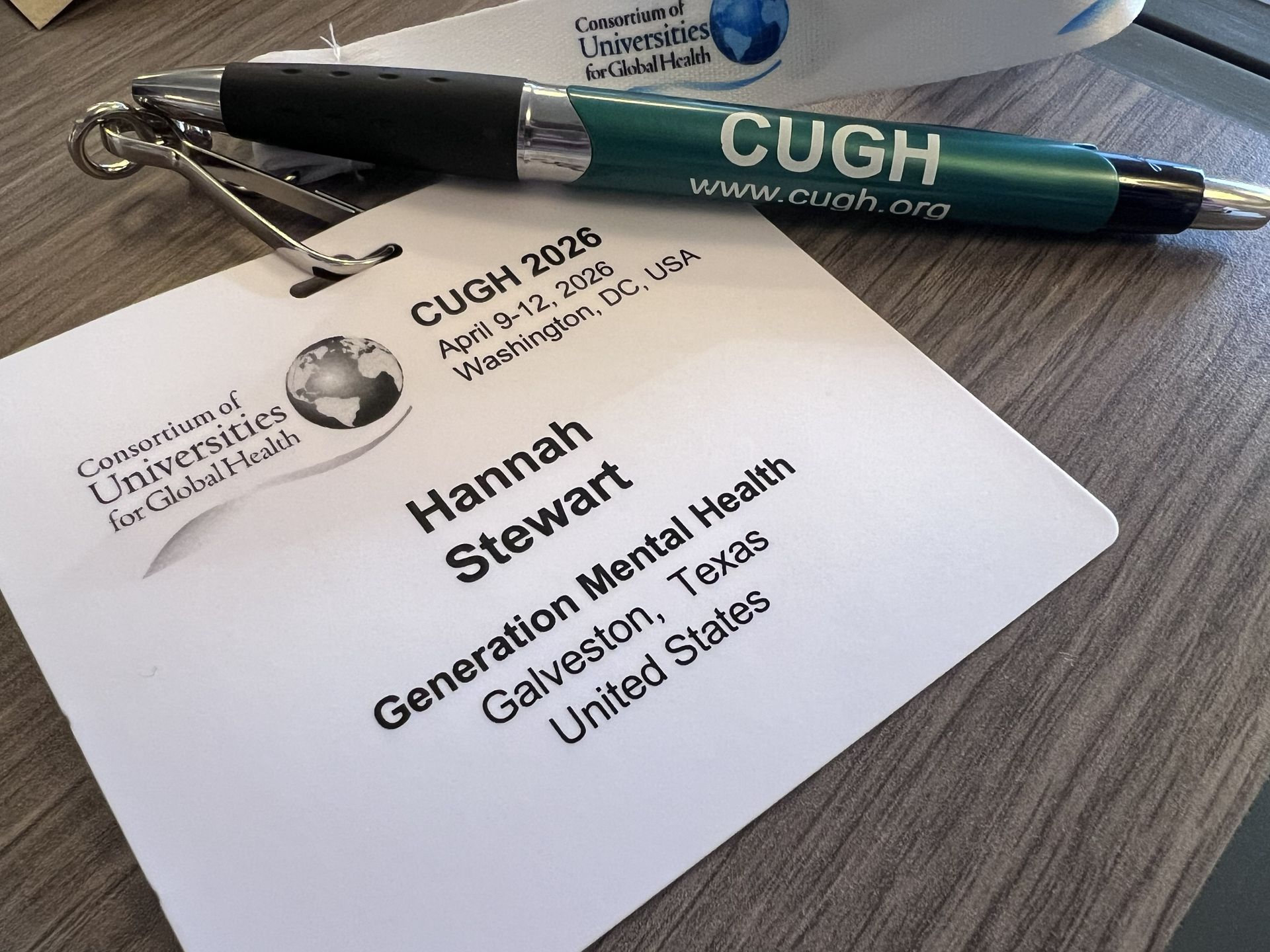
Last month, I attended the 2026 annual conference of the Consortium of Universities for Global Health (CUGH), where I found myself moving constantly between two worlds: academia and community, research and lived experience, institutional systems and grassroots realities, the introvert’s pull to stay in my hotel room and the necessary networking required of me.
In many ways, that dual positioning reflects my own role. I currently serve on CUGH’s Board of Directors and as Co-Chair of the Trainee Advisory Committee. I am also the Chief Research and Knowledge Officer here at Generation Mental Health, a role that allows me to bridge research, lived experience, and community partnership in global mental health work. Honestly, inhabiting both of those worlds is fulfilling. It also means that I spend a lot of time translating between them: connecting research to communities, communities to research, and helping people across sectors imagine what more equitable partnership could actually look like in practice.
The overall energy at CUGH this year felt both hopeful and urgent. It is clear that global health is entering a period of transition. Here in the United States, and in many countries globally, academic institutions and science are unequivocally under attack. At the same time, there is also growing pressure for global health institutions to think more critically about equity, partnership and community accountability.
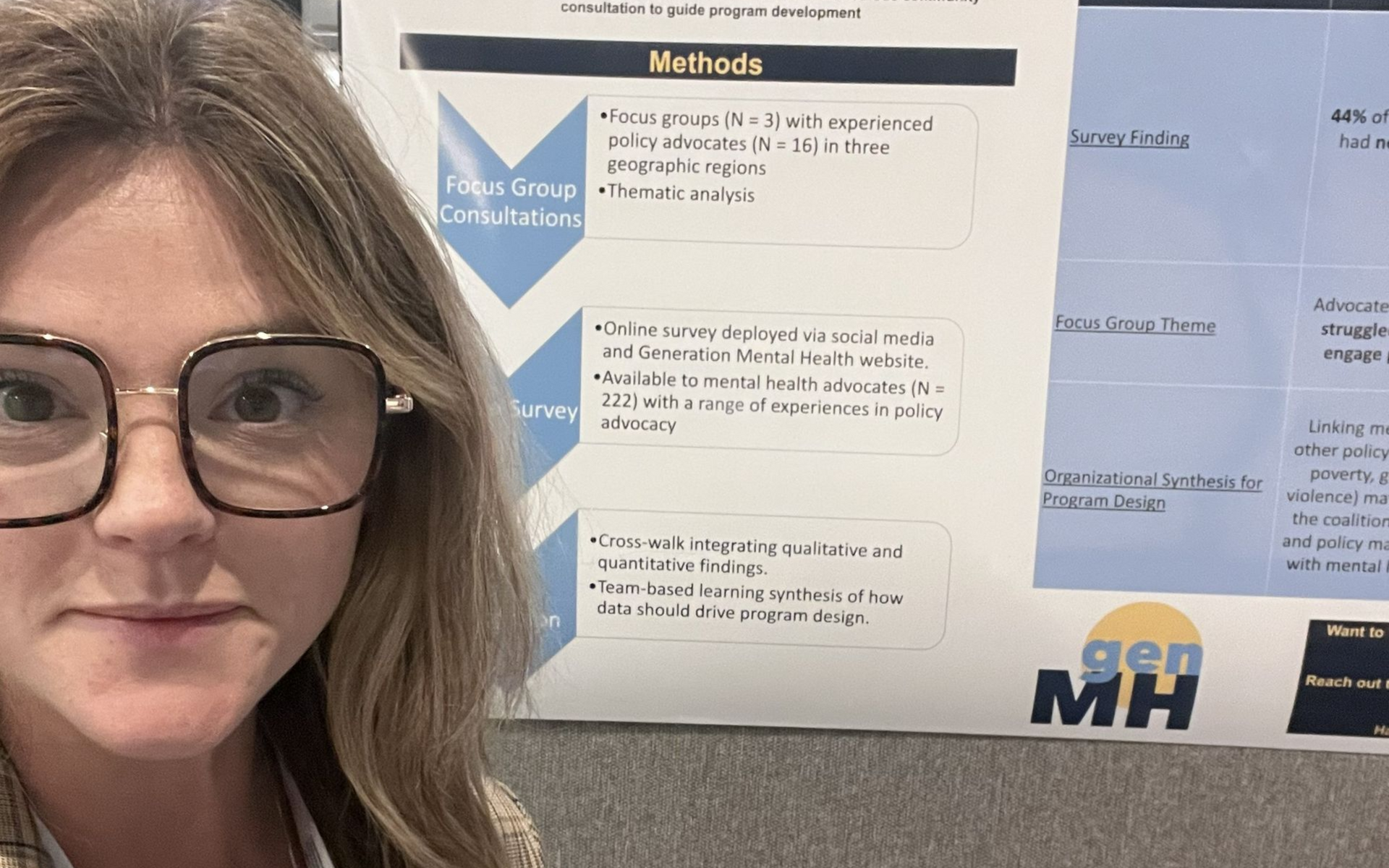
GenMH attended the conference not only to participate in those conversations, but also to showcase our work. We were fortunate to have two posters and two panel presentations included in the conference program, including presentations connected to grassroots global health approaches and lived experience-centered work. We also hoped to introduce more people within the broader global health ecosystem to our work, including our new initiative, the Possibilities Collective.
Reflection 1: What We Do at GenMH Resonates with People
What I did not fully anticipate, though, was just how many people would stop me throughout the week to talk about GenMH. Those conversations happened everywhere: after sessions, in hallways, in the hotel restaurant, and even unexpectedly in a coffee shop a few blocks away from the conference center (side note: I highly recommend Childhood Cafe in Washington, D.C., if you’re ever in the area!). Again and again, people approached me to say how excited they were by our work and how grateful they were that we, as a non-governmental organization, were willing to name the challenges that prevent equitable, community-led, and lived-experience centered global health work.
Every interaction felt like an opportunity to talk about our mission, our values and our vision for the future of global mental health. Candidly, I am an introvert. And I struggle with having to be always “on” in these settings. In a very human moment amid all the conversations about systems change and global health infrastructure, I also realized shortly after arriving that I had completely forgotten to bring business cards (rookie mistake). Thankfully, I was able to quickly make a digital version to share with people throughout the week. In hindsight, it felt strangely representative of the conference itself: lots of improvising, lots of relationship-building, and lots of people trying to create new ways of connecting. Most importantly, I was reminded of why I love lived experience work. The fact that I am a little socially awkward, a little rambling, and very myself (i.e., not artificially polished) allowed people to connect to me and the work of Generation Mental Health in a very relational way. People, even though outside of mental health, were excited about the lessons they could take away from the work we do here.
Reflection 2:
As the week went on, I found myself returning to the same core questions over and over again. Who gets to shape systems? Who gets recognized as an expert? What does meaningful community partnership actually look like?
Several conversations during the conference crystallized those questions for me.
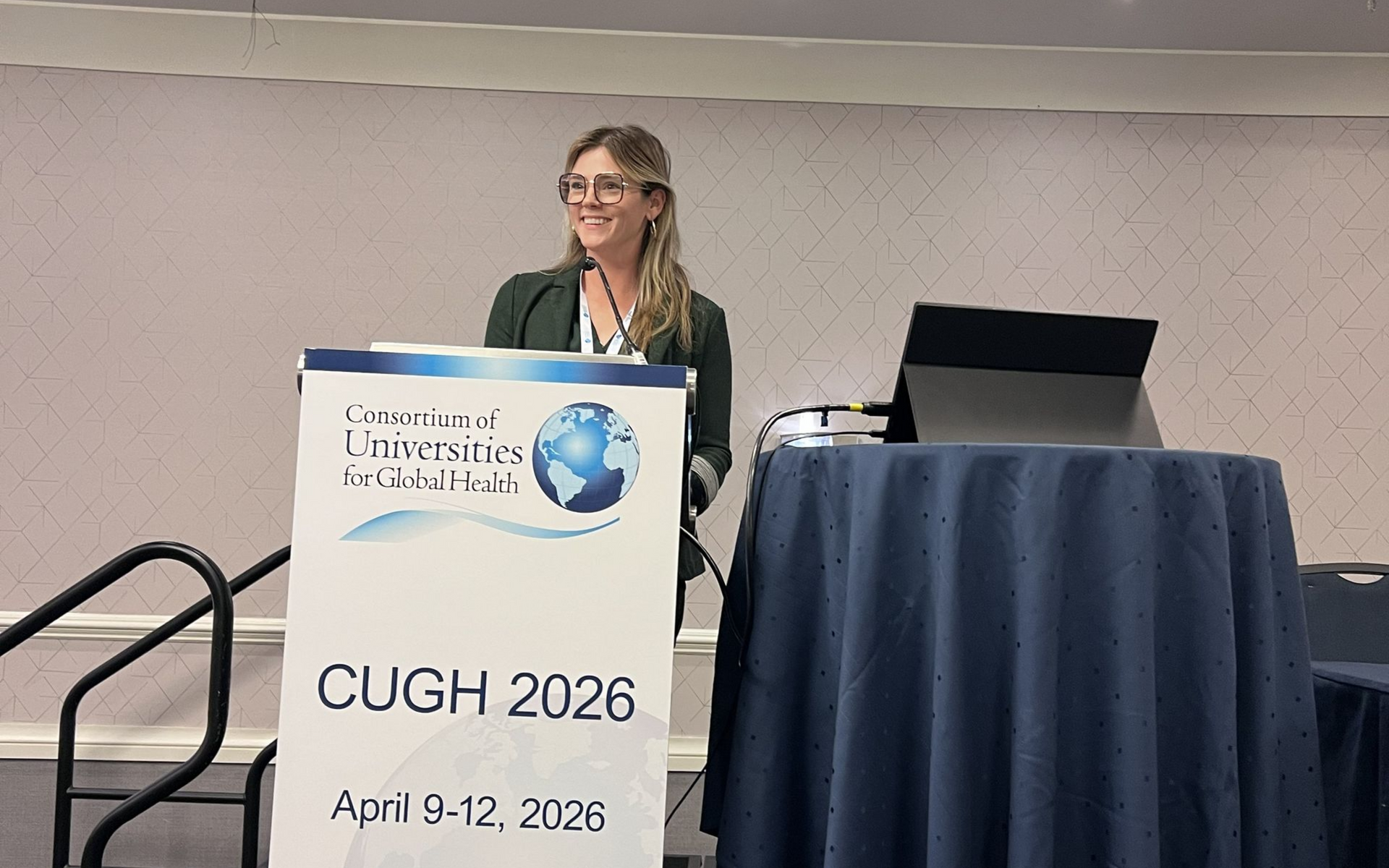
One was a panel discussion focused on decolonizing global health education. I knew going in that I was the only panelist not representing a university. Of course, this was not surprising. The conference is literally called the Consortium of Universities for Global Health. I felt like I had a unique platform in this particular panel. So, I took it. I spoke candidly about some of the contradictions involved in trying to “decolonize” systems that are still fundamentally organized around academic power and institutional authority.
As I spoke, I was surprised by the number of people throughout the room nodding emphatically. During the Q&A portion, one audience member even thanked me for naming some of those tensions out loud. The moment stayed with me because it reinforced something I had been sensing throughout the week: many people within institutions genuinely want change, but they are also navigating systems that make transformation difficult. And in this particular moment, where science and universities are under attack, critiquing the system (i.e., academia) can feel almost too uncomfortable. We can’t, in my opinion, fall prey to that fear. I believe that we must protect science from being diluted and weaponized by fascism. I also believe that we must not settle for a performative state of good enough.
Another conversation that stayed with me centered around the idea of “scale.” During a panel discussion, our panel asked what it would look like to “scale” approaches like ours that recognize mental health as deeply intertwined with culture, structural violence, social location, and community realities. I found myself pushing back (gently) against the framing of the question itself. What if scale isn’t always the outcome we should be prioritizing?
Community-rooted work is inherently relational and contextual. Some approaches may not be universally transferable, and that may actually be okay. In fact, it may be necessary. Not everything meaningful can or should be flattened into a standardized model that can be replicated everywhere in exactly the same way. Take the Possibilities Collective, for example. The programs that make up the Possibilities Collective are available globally, but our regional teams ensure that our approaches to community input and implementation are responsive to our target regions. While there will always be threads that pull the work together, what works in one region may not necessarily be effective or authentic in another.
None of these conversations offered easy answers. I certainly don’t claim to have the perfect answers myself. But they did remind me that people across many different sectors and institutions are wrestling with similar questions about power, legitimacy, partnership, and the future of global health work.
Reflection 3: Young people give me so much hope.
Despite those tensions, I left the conference feeling hopeful. I loved seeing an entire community show up to wrestle with these pain points in community with one another. What gave me even more hope, though, were the students.
Many students who attended our sessions seemed energized not just by the specifics of our work, but by the broader vision underneath it: the idea that we do not have to inherit systems exactly as they are. We can question them. We can reimagine them (yes, we can even break them a little). We can rebuild them in ways that more fully reflect our lived experiences and the realities of the communities we serve.
Organizations like Generation Mental Health have an important role to play in that process. We can help connect research to communities and communities to research. We can convene stakeholders across institutions and disciplines. And perhaps most importantly, we can continue showing up in spaces that may not always feel like they were built for us.
If there is one thing I hope people take away from these reflections, it is this: continue speaking about your work, even in spaces that may not seem like they were built for you. You may be the spark that space needs to think about things differently.