In Conversation with Maalvika Bhuvansunder, an IBD Patient-Advocate
A conversation with mental health professional and IBD advocate Maalvika Bhuvansunder on lived experience, community-led care, and the urgent need to integrate mental and physical health in chronic illness advocacy.
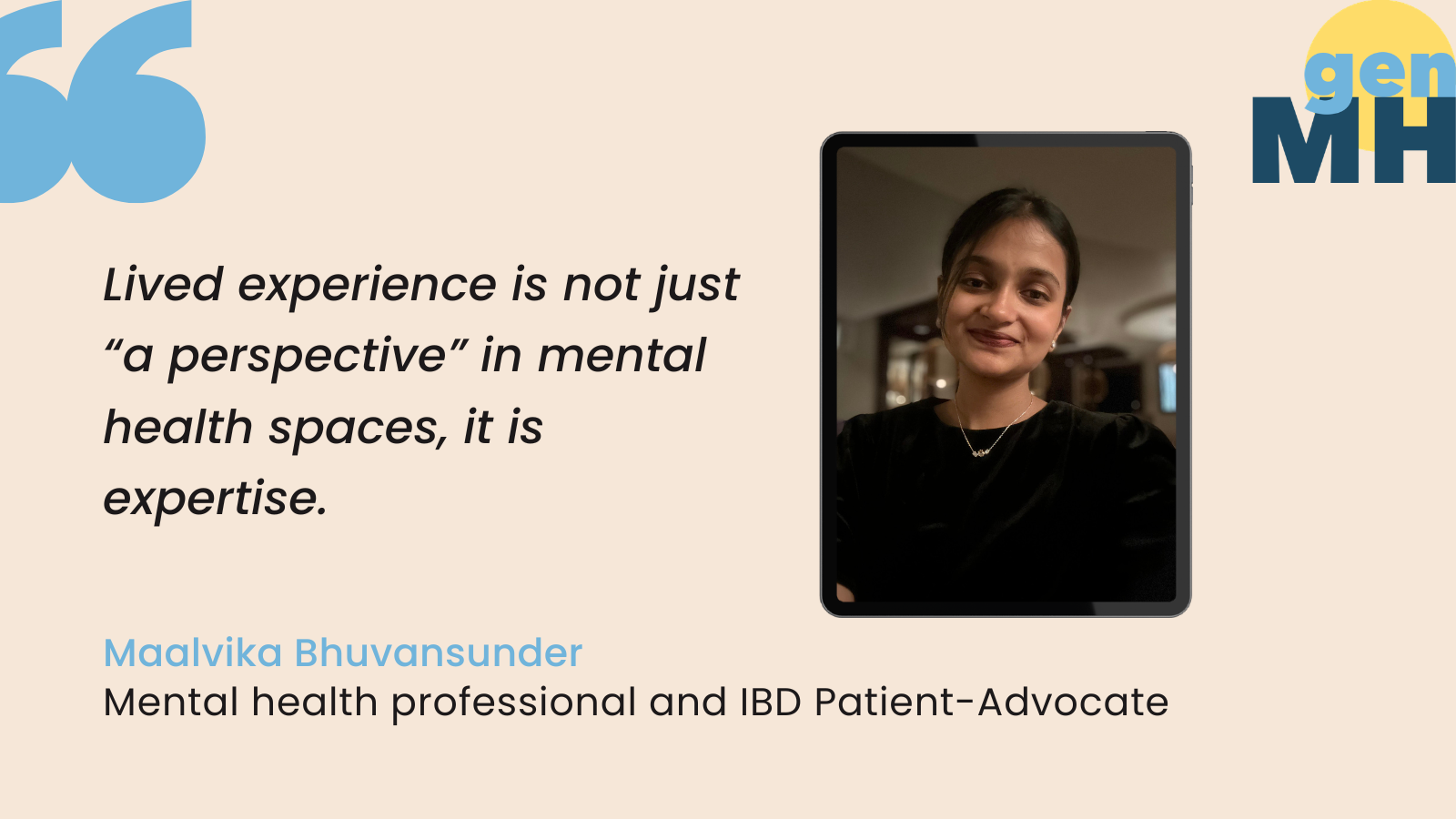
We are joined today by Maalvika Bhuvansunder, a mental health professional, who wears multiple hats in the advocacy space. She’s a volunteer with IBD Patient Support Foundation India, a non-profit organisation that supports persons with Inflammatory Bowel Diseases (IBD) in India, where she works with them on their mental health initiatives
She is also a peer group facilitator for the South Asian chronic illness group with
Generation Patient, a nonprofit organisation created by and for young adults living with chronic medical conditions. She was also the 2025 PxP steering committee member for their patients in Research Conference 2025. She has also briefly volunteered with Generation Mental Health in the past.
When her higher education and IBD diagnosis overlapped in 2016, the intersection of physical and mental health advocacy became inevitable. What drew her to IBD advocacy was the Crohn's and Colitis Young Adult Network fellowship, a community for YA with IBD. Through them, she also had the chance to connect with Nikhil, the founder of IBD India.
We chat with her about her journey and discover the mental health toll that IBD takes, and the resources available to help manage it.
Kritika (GenMH): In what ways has your personal background, whether professional, academic, or lived experience, shaped the advocate you’ve become?
Maalvika: Being a mental health professional, I have always loved being part of community-based projects and initiatives. I’ve always believed in working at the grassroots, in listening, in building systems that actually serve the people they are meant for. But when I was diagnosed with Crohn’s disease, it stopped being just professional; it became deeply personal.
My diagnosis hit me like a brick. I felt lonely, overwhelmed, and honestly quite invisible. I understood the theory behind coping and resilience, but living through it was different. The fear, the uncertainty, the silence around chronic illness, especially in our context, made me realise that there is a huge gap between knowledge and lived reality. That is when I knew something needed to be done.
CCYAN gave me that platform. It connected me with other young adults living with the same condition and showed me what a community can truly look like. Being in a space where you don’t have to over-explain, where your fears are understood without judgment, and where your struggles are not minimised. It made me realise how powerful lived experience is when it is organised, supported, and amplified.
Today, my advocacy is shaped by both who I am professionally and what I have lived through personally.
Kritika (GenMH): Could you walk us through a project or campaign that you feel captures the essence of your advocacy? What does it aim to change or address?
Maalvika: In collaboration with the Mariwala Health Initiative at IBD India, we trained the iCall TISS helpline counsellors on the nuances of living with a chronic illness to educate more mental health professionals. We had reached out to the MHI outreach team, submitted a proposal and received funding to carry out this project. We were able to train over 20 counsellors, and it felt great to impart lived-experience knowledge to my fellow MHPs.
Another project that I am really proud of was organising the PXP regional webinar in India. We coordinated with other patient advocacy groups in India and, with PXP’s help, conducted an online panel discussion on the importance of patient partners in research and at the point of care.
The virtual conference symposium for GenMH “Silent No More: We Are the Story and the Solution,” truly captures the essence of my advocacy because it brings together everything I stand for: lived experience, suicide prevention, structural inclusion, and youth leadership. We intentionally built a diverse, international panel of young advocates from both LMIC and high-income contexts, all under 30, all living with chronic illness. The structure was deliberate. It centred around individual lived narratives framed through systemic issues: medical gaslighting, health anxiety, barriers in LMICs, trauma-informed care, peer support, and youth leadership in policy.
Kritika (GenMH): What have been some learnings from working on these initiatives?
Maalvika:
One, the power of advocacy, when collective voices come together, the power it holds. Two, the importance of collaboration. To bring a change, collaboration is very important. And finally, how important mental health is when advocating for chronic illness.
Kritika (GenMH): How do you see the cultural context determining the attitude towards the intersection of chronic illnesses and mental health that your advocacy operates in?
Maalvika: In India, the focus is often on physical symptoms, while the emotional toll is minimised or stigmatised. Socio-economic barriers such as affordability, limited access to integrated care, and uneven access further affect treatment and recovery. People are often made to choose between either physical healthcare or mental healthcare, as it might not be affordable. This should not be a choice but a right for every individual.
Family dynamics can be supportive but may also discourage open conversations about mental health. In contrast, high-income countries may have better structural access but still face fragmentation and stigma.
Reflections on Advocacy & Global Mental Health
Kritika (GenMH): From your perspective, what is the most crucial element in designing an effective mental health intervention or advocacy campaign?
Maalvika: Clarity of purpose. You need to deeply believe in the issue you are working on. For me, it starts with identifying an area that truly matters to you, something that feels urgent, personal, and worth committing to long-term.
Kritika (GenMH): How do you view the role of lived experience in shaping meaningful mental health solutions and movements?
Maalvika: Lived experience is not just “a perspective” in mental health spaces, it is expertise. Living with Crohn’s disease, even in remission, has shown me how chronic illness carries a constant psychological stressor: hypervigilance about symptoms, fear of relapse, anxiety around long-term medication, body image concerns, uncertainty in relationships, and the quiet exhaustion of having to repeatedly explain your condition.
In South Asian contexts, where awareness of invisible illnesses is limited, this is compounded by minimisation and stigma. The mental health toll is not only about depression or anxiety, but it’s also about anticipatory grief, identity shifts, loneliness in hospital rooms, and the pressure to appear “fine” when your body has a history of betrayal. Lived experience creates a community in that silence. It transforms private distress into collective language and pushes movements beyond awareness toward structural compassion in healthcare systems, families and policies. When those who have carried the weight are centred, solutions become more humane, realistic, and deeply informed.
Kritika (GenMH): If you could shift one thing: policy, narrative, funding, access, or stigma, what would make the biggest difference?
Maalvika: If I could shift one thing, it would be policy backing because policy is what translates empathy into accountability. We have narratives. We have awareness campaigns. We even have passionate advocates. But without formal policy integration, chronically ill youth continue to fall through the cracks of both physical and mental healthcare systems.
Right now, chronic illness and youth mental health are often treated as parallel conversations rather than intersecting realities. There is very little structured mandate requiring integrated care models, routine mental health screening in gastroenterology or speciality clinics, trauma-informed protocols, or patient partnership frameworks in research. Without policy-level recognition, these practices remain optional rather than essential. Stigma matters. Access matters. Funding matters. But policy sustains change. For me, shifting policy is about moving from “this would be nice to have” to “this is required.” And that is what would make the biggest difference.
Looking Ahead
Kritika (GenMH): Looking forward, what feels like the most urgent issue or gap in global mental health that you believe needs addressing? Is there anything you wish more people understood about mental health advocacy?
Maalvika: I THINK MORE INVOLVEMENT OF LIVED EXPERIENCE IS WHAT IS REQUIRED! Instead of just being used as propaganda, lived experience should be incorporated into all aspects of mental health initiatives. As a mental health professional, I know how important it is to listen to the voices the interventions are designed for, and to ensure the highest quality of care, it is vital to incorporate them. Especially when we talk about chronic illness and mental health, which is still a little underresearched, listening to the people experiencing it first-hand will be a game-changer, as they will help inform the care that is required.
Kritika (GenMH): What message or encouragement would you offer to someone who wants to get involved (in advocacy) but doesn’t know where to start?
Maalvika: Explore organisations that are run by YA who are in some form related to or have been through what they are advocating for.
I would also urge others to take things slow if advocacy feels too heavy. It is OK to PAUSE, take a break and distance yourself if it feels too much. Nothing should come at the cost of your well-being.